

















It’s difficult to stay on top of all the drugs and names that come with them, especially when they’re relatively new drugs, or drugs that have recently become popular. Bromazolam is a synthetic benzodiazepine that has become common in the illegal substance market. It can be packaged to look like Xanax tablets, which makes it particularly dangerous.
Bromazolam has effects that are similar to opioids. It’s addictive, can be fatal when taken in high doses, and it produces withdrawal symptoms that make it life-threatening if use is suddenly stopped. These characteristics are why the DEA recognized bromazolam as a Schedule I drug in 2025, making it a criminal offense to manufacture, distribute, and possess bromazolam [1].
Here’s what you need to know about bromazolam, including its effects, risks, and treatment options.
What Is Bromazolam & What Effects Does It Have?
Bromazolam is a designer benzodiazepine, which means it’s manufactured in a lab. It’s chemically similar to alprazolam, the brand name for Xanax.
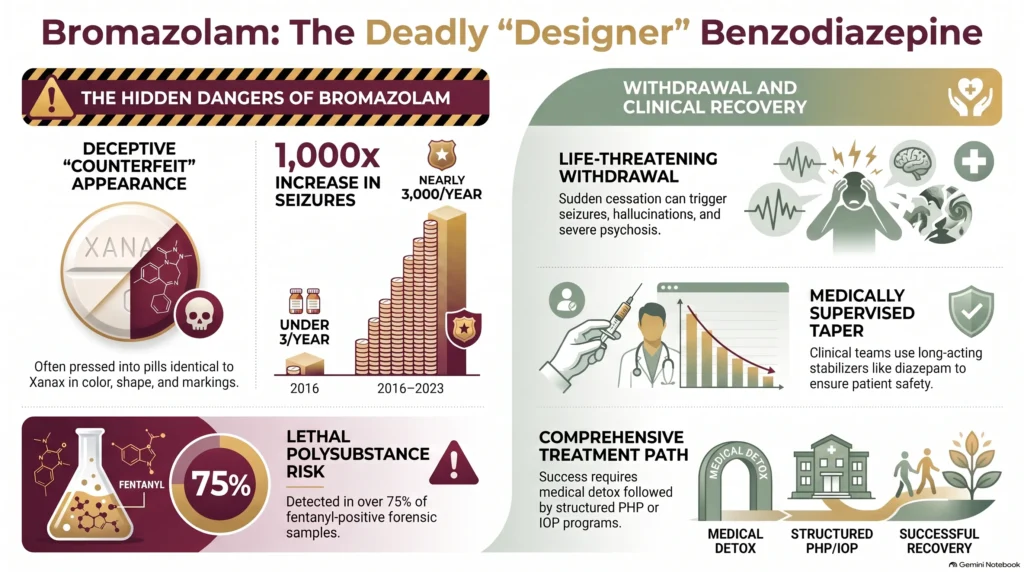
Bromazolam has never been approved for medical use and does not treat anything. It was first made in the 1970s during pharmaceutical research but never went further. In 2016, it surfaced in Europe as an illegal drug and made its way to the US by 2019. From 2016 to 2023, seizures of bromazolam in the US increased from fewer than three per year to nearly 3,000 per year [1].
The drug mimics the effects of prescription benzodiazepines. It binds to GABA-A receptors in the brain, producing a feeling of sedation, relaxing muscles, and lowering anxiety. In high doses, bromazolam can lead to deep sedation and amnesia [2]. Most recreational users take the drug to feel euphoria and reduced inhibition. Effects typically onset within 15 to 45 minutes of taking it and can last for up to eight hours.
Combined with other central nervous system depressants, bromazolam can cause respiratory depression, loss of consciousness, and death.
Bromazolam vs Xanax
Bromazolam is not the same as Xanax, which is a legal drug to treat anxiety disorder and panic disorder, available with a prescription.
However, bromazolam is often pressed into counterfeit Xanax pills that look exactly like the legitimate prescription version, with the same color, shape, and markings. The difficulty distinguishing bromazolam from Xanax means more people are at risk of consuming a different, and substantially more potent substance, when taking the pills.
In 2023, three young adults took counterfeit Xanax pills containing bromazolam. They all experienced multiple seizures, had to be admitted to the ICU, and had to be intubated. All were given naloxone, but they remained unresponsive. Two of the young adults recovered, while one had epileptic seizures and fell into a coma [1].
Beyond Xanax, bromazolam has been detected in fentanyl and other illicit opioids. Co-detections with fentanyl showed up in more than 75% of bromazolam-positive samples from forensic analyses [3].
What Happens During Bromazolam Withdrawal?
Bromazolam is addictive and stopping it suddenly or dramatically lowering the dose can be dangerous. Similar to other benzodiazepines, bromazolam addiction produces withdrawal symptoms and needs to be slowly tapered off under the guidance of a medical detox program.
Unlike benzodiazepines, though, bromazolam is unregulated and people may consume higher doses than they realize. This variation heightens the risk of developing physical dependence faster and withdrawal being more severe.
Common withdrawal symptoms that manifest during bromazolam withdrawal are:
- Anxiety
- Panic attacks
- Problems sleeping
- Stomach issues
- Sweating
- Shaking
- Muscle ache
- Restlessness
In severe cases, seizures, hallucinations, and psychosis may develop during withdrawal. These require immediate medical intervention and are part of the reason why bromazolam withdrawal should not take place alone.
Is There Treatment for Bromazolam Use?
Yes, treatment helps anyone who is using (knowingly or unknowingly) bromazolam, and who has a substance use disorder. Treatment comes as medically supervised detox, where a person safely withdraws under a licensed clinical team, and is monitored while they find stability.
Because of the potency of bromazolam, medical detox typically uses a long-acting benzodiazepine such as diazepam to help people slowly taper off, and to alleviate cravings and severe withdrawal symptoms. Using diazepam in this scenario does not mean replacing one substance with another — it is necessary to allow the body to function without the presence of bromazolam.
The inconsistency of bromazolam doses, and because many people may genuinely not know they’ve been taking it, are why a comprehensive intake evaluation determines the extent of dependency, as well as evaluates other health risks that need to be considered for safe, successful detox.
Effective Addiction Treatment with Red Rock Recovery
We’re an addiction treatment center located in Denver, CO. We offer medical detox to support anyone removing bromazolam from their system. Our team are all licensed clinical professionals, who work with empathy and always prioritize your safety and well-being.
We also offer care for when you finish medical detox. Our Partial Hospitalization Program (PHP) and an Intensive Outpatient Program (IOP) continue your recovery journey, providing care that is tailored to your needs and goals. Our approach is evidence-based and rooted in more than just treating symptoms — we help you understand what drives addiction and how to overcome it.
Your next step can be transformative. Contact us today.

Sources
[1] United States Drug Enforcement Administration. 2026. DEA Emergency Schedules Bromazolam. dea.gov.
[2] Edinoff, A. et al. 2022. Novel Designer Benzodiazepines: Comprehensive Review of Evolving Clinical and Adverse Effects. Neurology International.
[3] The Center for Forensic Science Research & Education. 2022. Bromazolam Prevalence Surging Across the United States Driven In Part by Increasing Detections Alongside Fentanyl. cfsre.org.