

















We live in a world where drinking alcohol is normalized. For many people, having a drink with dinner, while out with friends, or even as a way to unwind after a long day is fine — maybe even encouraged. Drinking every day, though, exceeds the parameters of social drinking and may signal addiction.
Alcohol use disorder (AUD) is common: in the US alone, nearly 28 million people have an addiction to alcohol [1]. What then is the difference between social drinking and having a problematic relationship with alcohol? If you’re drinking every day, for example, does that count as social drinking or an indication of a deeper issue?
Let’s take a look at what AUD is, how it’s different from social drinking, but also how the two are related.
What Is Social Drinking?
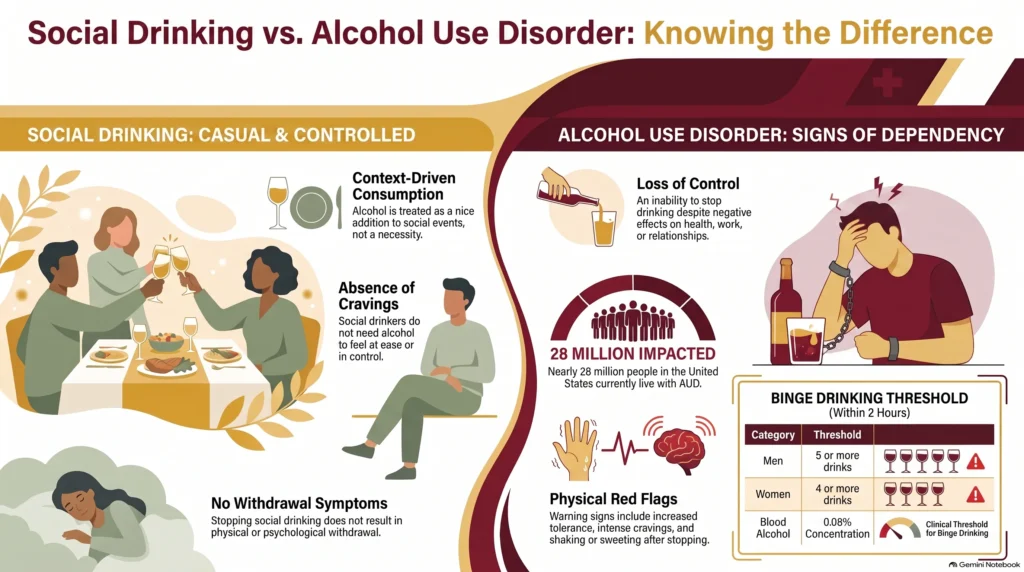
Social drinking refers to when you consume alcohol in the company of others, normally at a party, in a bar, with food, or while relaxing. When social drinking, people tend not to drink excessively. There’s also an important distinction that social drinkers do not crave alcohol in the moment: they don’t need it to feel at ease or to feel in control.
In social drinking contexts, alcohol is treated as a nice addition, not a necessity. If a person stops drinking socially, they won’t experience withdrawal symptoms.
Social drinking is not a formal medical term, but medical staff understand the place of alcohol in society, and so use it to distinguish if someone is drinking casually and with control, or if they have a dependency.
What is AUD?
Alcohol use disorder is when someone has a pattern of being unable to stop or reduce drinking alcohol, despite it having negative effects on their health and life. It’s a medical diagnosis and is sometimes called alcoholism or alcohol addiction. AUD impacts daily functioning, employment, relationships, and physical and mental health.
People with AUD often attempt to cut back their alcohol intake but are unsuccessful. They may hide how much they drink, prioritize drinking over other plans, and consume alcohol in unsafe environments such as when driving. The more they drink, the higher their tolerance for alcohol is, and the more alcohol they consume to achieve the same effects as before.
Withdrawal symptoms arise for half of people who have AUD when they quit or significantly reduce how much alcohol they drink [2].
What Are Signs of AUD?
AUD is not always obvious, especially when people who have the condition can enable their addiction through societal norms around alcohol. However, common signs include:
- Craving alcohol
- Spending time thinking about, buying, and consuming alcohol
- Missing deadlines or performing worse at work or school because of alcohol
- Continuing to drink even when it causes problems at work/school, in relationships, and with health
- Giving up activities and connections that bring joy to drink instead
- Shaking and sweating after not drinking alcohol consistently
Binge drinking is also an indication of AUD. It’s the opposite of social drinking, where a person drinks heavily in a short space of time, so much so that their blood alcohol concentration rises to 0.08% [3]. Binge drinking for men involves having five or more alcoholic drinks within two hours. For women, it’s four alcoholic drinks within two hours [4].
Can Social Drinking Lead to AUD?
Yes, social drinking can lead to AUD. Not everyone who drinks socially will develop AUD, but people who socially drink on a regular basis, as well as people who are already at risk of AUD, are more likely to become addicted to alcohol.
The following factors mean social drinking can heighten the risk of AUD:
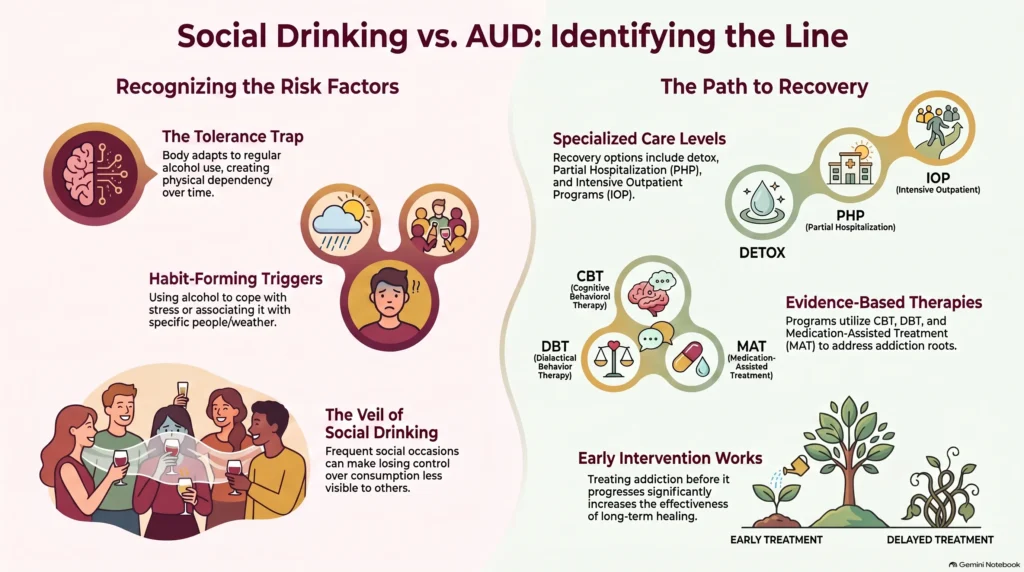
Increased tolerance for alcohol. Even on a prolonged casual basis, the body can adapt to alcohol and develop a dependency over time.
Consistency and control. The more often you drink socially, the easier it is to justify having more alcohol more often. The veil of social drinking makes losing control less visible.
Habit-forming behaviors. Repeat social drinking can encourage behaviors that lead to addiction. For example, seeking an alcoholic drink to cope with a stressful day or to talk about a specific subject with friends.
Triggers. If you associate warm weather or seeing a particular person with drinking alcohol, it becomes hard to separate the connection, and can make those things difficult to encounter without alcohol.
Research shows that social drinking can be both a pathway to AUD, and the place where AUD manifests [5]. Drinking in social settings has even been associated with negative alcohol-related outcomes that are markers of AUD. For example, alcohol-induced violence, sexual assault, and risky sexual behavior [6].
When Does Social Drinking Require Intervention?
If you’re worried about your drinking habits or those of someone you love, it’s always worthwhile having a conversation. The talk shouldn’t assume anything or carry judgment, it’s best to approach the topic with care and curiosity.
Ask yourself or your loved one:
- How much are you drinking on social occasions?
- Do you look forward to these occasions because alcohol will be there?
- Do you exceed the amount you plan to drink?
- Have you attended social settings and drank even when you’ve felt unwell or have had other responsibilities to attend?
- Are you typically the last person at the social event? Do you try to convince people to stay and continue drinking with you?
- Do you wake up hungover after social drinking?
These questions can prompt self-reflection and honesty that can help you or someone else get support for AUD as early as possible.
Treatment for AUD is accessible and highly effective. You can choose from detox, in-patient residential care, and outpatient programs that allow you to live at home while undergoing care. Most programs integrate evidence-based therapies such as Cognitive Behavioral Therapy (CBT) and Dialectical Behavior Therapy (DBT) to delve into the deeper causes of addiction and self-worth, alongside wellness activities that nurture physical and mental health.
Medication-assisted treatment (MAT) is also available to alleviate cravings and severe withdrawal symptoms while you move forward in recovery.
Studies show that early intervention is effective to treat addiction before the condition can progress [7]. The sooner you can recognize that social drinking has become harmful, the sooner you can begin to heal.
Start Feeling Better with Red Rock Recovery
We’re an addiction treatment center located in Denver, CO. We offer detox, a Partial Hospitalization Program (PHP), and an Intensive Outpatient Program (IOP) to help you find stability and a healthier life without alcohol. We also have a dual diagnosis program to treat people with addiction and a co-occurring mental health disorder.
We work using evidence-based therapies, MAT, and holistic activities. Our comprehensive care ensures that all of you is seen and factored into your treatment. We understand that social drinking can be a subtle, but important, element of your addiction story, and we work with you to understand your triggers and behaviors.
Your next step can be the most transformative. Contact us today.

Sources
[1] National Institute on Alcohol Abuse and Alcoholism. August 2025. Alcohol Use Disorder (AUD) in the United States: Age Groups and Demographic Characteristics. niaaa.nih.gov.
[2] Cleveland Clinic. January. 2024. Alcohol Withdrawal. my.clevelandclinic.org.
[3] National Institute on Alcohol Abuse and Alcoholism. February 2025. Understanding Binge Drinking. niaaa.nih.gov.
[4] Mayo Clinic. May 2022. Alcohol Use Disorder. mayoclinic.org.
[5] Fairbairn, C. Kang, D. August 2025. Social Drinking and Addiction: A Social-Cognitive Model for Understanding Alcohol Use Disorder Risk. Current Directions in Psychological Science.
[6] Creswell, K. December 2020. Drinking Together and Drinking Alone: A Social-Contextual Framework for Examining Risk for Alcohol Use Disorder. Current Directions in Psychological Science.
[7] US Department of Health and Human Services; 2016 Nov. CHAPTER 4, EARLY INTERVENTION, TREATMENT, AND MANAGEMENT OF SUBSTANCE USE DISORDERS.