

















Benzodiazepines (benzos) are prescription drugs that include alprazolam (brand name: Xanax), diazepam (brand name: Valium), and lorazepam (brand name: Ativan). They’re used to treat anxiety, panic disorder, and alcohol withdrawal. While benzos are highly effective, they’re equally addictive, and suddenly stopping a course can not only cause side effects but be life-threatening.
In the U.S. alone, 92 million prescriptions for benzodiazepines were dispensed in 2019. Of those people, nearly half ended up taking the drugs for two months or more — much longer than the short-term period benzos are intended for [1].
Let’s take a look at what exactly benzos are, how they work, and why they require a slow tapering-off instead of a hard quit.
What Are Benzos And How Do They Work?
Benzos are sedatives: they slow down activity in the brain and central nervous system. They’re only available with a prescription from a physician and come as short-acting (which only last hours) or long-acting (which last days) drugs.
Benzos work by increasing the release of gamma-aminobutyric acid (GABA), a neurotransmitter in the brain. GABA makes the central nervous system less active, helping to lower anxiety, produce sleepiness, and relax muscles. Research emphasizes the effectiveness of benzos, especially for generalized anxiety disorder, panic attacks, social phobia, and insomnia [2].

Are Benzos Addictive?
Yes, benzos are addictive. Because they increase the release of GABA, they also cause dopamine neurons in the brain to fire, which can fuel habit-forming behaviours [3]. In fact, even someone who doesn’t take more than their prescribed dose, at the prescribed frequency, can develop a dependency on benzos.
One study even found many physicians prescribe benzos to patients who are already at risk of a substance use disorder [4].
With steady benzo use, the brain adjusts to the higher levels of GABA, and starts to produce less of its own natural calming signals (known as “neuroadaptation”). If benzos are suddenly stopped, there’s a chemical imbalance that triggers withdrawal, where the body enters homeostasis and tries to recalibrate its systems. This state is known as withdrawal.
What Is Benzodiazepine Withdrawal?
Benzodiazepine withdrawal is the emotional and physical responses to stopping or dramatically reducing benzos after a period of use. It varies from person to person, but symptoms typically include:
- Irritability and anxiety
- Sweating
- Difficulty concentrating
- Nausea
- Heart palpitations
- Headaches
- Sleep disturbance
- Muscle ache
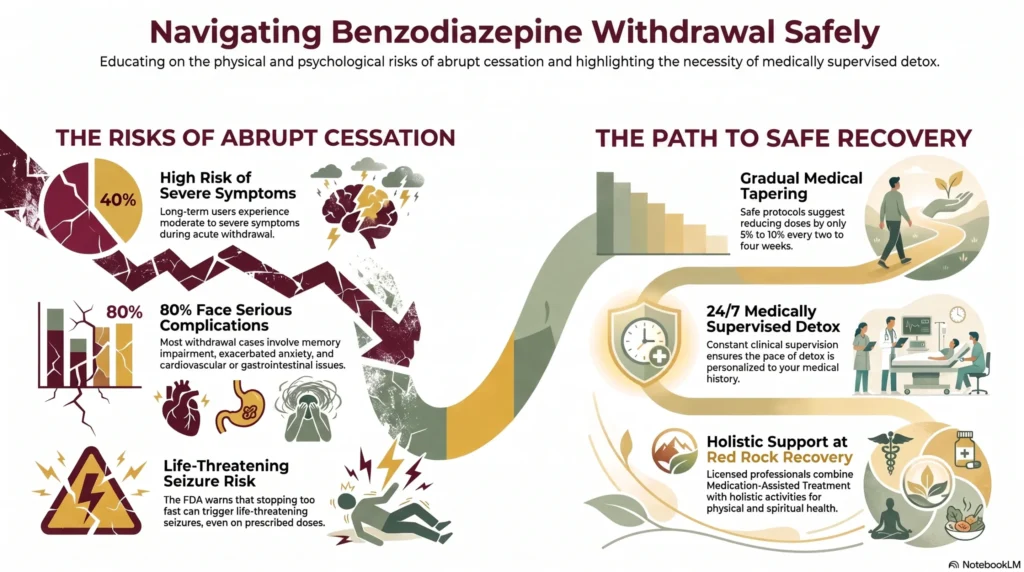
Seizures and psychotic reactions are also possible symptoms. For people who have taken benzos for longer than six months, 40% experience moderate to severe withdrawal symptoms during acute withdrawal [5].
Withdrawal can start as soon as one day after the last dose for short-acting benzos. Long-acting benzos can delay the onset of withdrawal by up to one week. For most people, symptoms begin between day 1 and 4, and full withdrawal lasts 10 to 14 days [6].
Is Benzo Withdrawal Dangerous?
Yes, it can be. The FDA released a specific warning around the possible consequences of stopping benzos too fast, stating that it can trigger life-threatening seizures. The FDA also found that around 80% of benzo withdrawal cases involved memory impairment, exacerbated anxiety, and cardiovascular and gastrointestinal symptoms [6].
Even if people follow the recommended benzo dose from their physician, there is still a risk. A separate study found that among people who had a seizure during benzo withdrawal, most had followed their prescribed dose [7].
Elsewhere, psychotic reactions including agitation, confusion, and disorientation were recorded in patients withdrawing from high daily doses of benzos. None of the patients had had previous psychotic episodes [8].
What’s The Safest Way to Stop Benzos?
The safest way to stop benzos is through a medically supervised detox. These programs ensure that people gradually taper off benzos, helping limit withdrawal symptoms, lower the risk of seizures, and facilitate the body’s natural chemical restoration.
Formal guidelines suggest that benzo dose should be reduced 5 to 10% every two to four weeks, and should never exceed a 25% reduction within a two-week period [9]. Even with those parameters (almost impossible to track without medical intervention), stopping benzos has to be a personalized process.
Medically supervised detox means that individuals are supervised 24/7 and receive care that aligns with their clinical history and current health. The pace of detox is equally structured around the person, factoring in existing disorders.
Moreover, medically supervised detox provides clinical and emotional support that makes a person more likely to successfully finish detox and establish a healthy relationship with benzos moving forward. If necessary, detox can also encourage people to seek further treatment, including residential and outpatient programs to address underlying causes of addiction.
Medically Supervised Detox at Red Rock Recovery, Denver
At our center in Denver, Colorado, we offer medically supervised detox, where you can safely withdraw from substances such as benzodiazepines and build (or maintain) long-term stability in your life.
All of our team are licensed professionals who work with expertise and empathy. We curate care around your needs and goals, and we provide a judgement-free space for you to

Sources
[1] FDA US Food & Drug Administration. (September 2020). FDA requiring Boxed Warning updated to improve safe use of benzodiazepine drug class. fda.gov.
[2] Chang, Y. et al. (April 2024). Exploring clinical applications and long-term effectiveness of benzodiazepines: An integrated perspective on mechanisms, imaging, and personalized medicine. Biomedicine & Pharmacotherapy.
[3] Tan, K. et al. (February 2010). Neural bases for addictive properties of benzodiazepines. Nature.
[4] Kroll, D. et al. (May 2016). Benzodiazepines are Prescribed More Frequently to Patients Already at Risk for Benzodiazepine-Related Adverse Events in Primary Care. Journal of General Internal Medicine.
[5] Regina, A. et al. (September 2024). Withdrawal Syndromes. StatPearls.
[6] Pétursson, H. (November 1994). The benzodiazepine withdrawal syndrome. Addiction.
[7] Fialip, J. et al. (December 1987). Benzodiazepine withdrawal seizures: analysis of 48 case reports. Clinical Neuropharmacology.
[8] Preskorn, S. Denner, L. (January 1997). Benzodiazepines and Withdrawal Psychosis. Report of Three Cases. JAMA.
[9] Brunner, E. et al. (June 2025). Joint Clinical Practice Guideline on Benzodiazepine Tapering: Considerations When Risks Outweigh Benefits. Journal of General Internal Medicine