

















A virtual Intensive Outpatient Program (IOP) is when you receive addiction or mental health care remotely via an online platform. Some people worry that not being present at a health facility while undergoing care jeopardizes the quality of treatment, but this is not true. A virtual IOP can be just as effective as in-person treatment.
Advancements in technology and people’s expectations of how care is delivered mean that virtual IOPs have become more common. Not only do virtual IOPs offer flexibility and privacy to people, they expand the pool of who can access care. When geographical and financial factors cause barriers to attending sessions at a center, virtual programs help.
In this article, I explain why a virtual IOP is as equally high-quality as face-to-face recovery programs.
What Is a Virtual IOP?
A virtual IOP is an online treatment program for addiction and/or mental health disorders. Sessions take place via a secure platform, such as HIPAA-compliant Zoom for Healthcare (which is different from commercial Zoom and is what we use at Red Rock Recovery).
With a virtual IOP, your treatment plan is mostly the same as it would be for an in-person program. Your sessions include evidence-based therapies led by a licensed clinician — these can be individual sessions or group ones.
If you take medication, you have check-ins with a doctor about your dosage and its effects. You may also participate in wellness activities during sessions, such as remote yoga, meditation classes, and art therapy activities.
There are some instances when care has to be modified to fit the virtual format. For example, a wellness activity such as hiking can’t be offered remotely. Instead, your care team may ask you to have a session outdoors, and guide you through strategies to help you connect with nature.
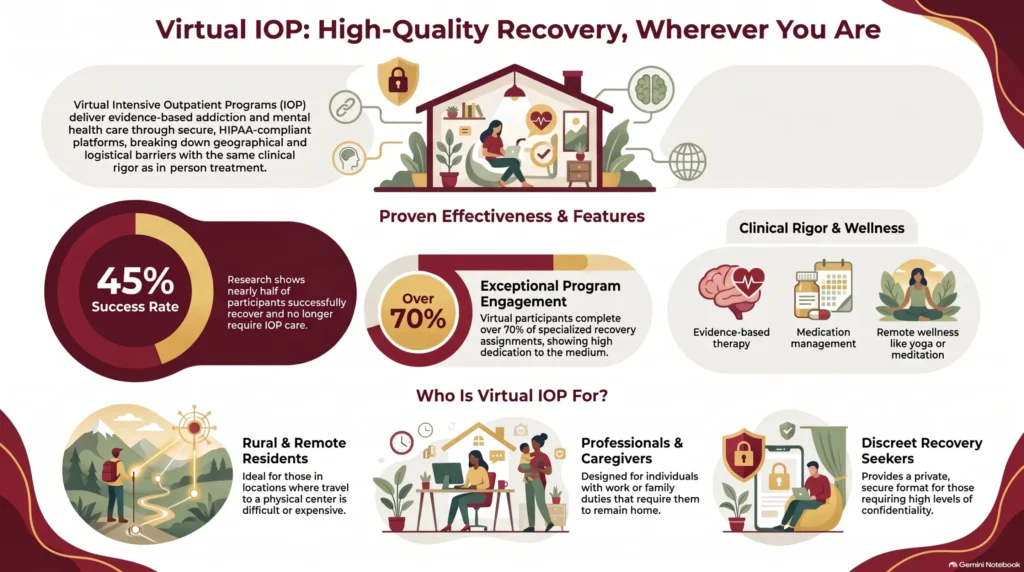
Research shows that 45% of people demonstrated a successful response to virtual addiction care and no longer needed IOP. It also showed high engagement with this medium: those who finished the program completed more than 70% of the assignments specially designed for the virtual setting [1].
Who Is a Virtual IOP For?
A virtual IOP can treat anyone who needs help with substance use or their mental health. Most people who join a remote program meet at least one of the following criteria:
- Live in a rural location, which makes traveling to a center difficult or expensive
- Work, have a family, or other responsibilities that mean they need to be at home
- Have a condition that limits them from leaving the house or interacting easily with others
- Have already completed an in-person IOP and want to try an alternative format
- Have finished a residential or PHP program and want to continue treatment, or are in the early stages of recovery and require more than weekly therapy
- Have a position or status where they need treatment to be especially discreet
What Are the Benefits of a Virtual IOP?
There are many advantages to joining a virtual IOP, some of which overlap with an in-person IOP and others that are unique to telehealth.
- Flexibility to study or work while undergoing care
- Be in a familiar setting and stay close to personal networks (which can heighten the effectiveness of treatment)
- Integrate skills learned in treatment more seamlessly into daily life
- Develop a deeper sense of independence
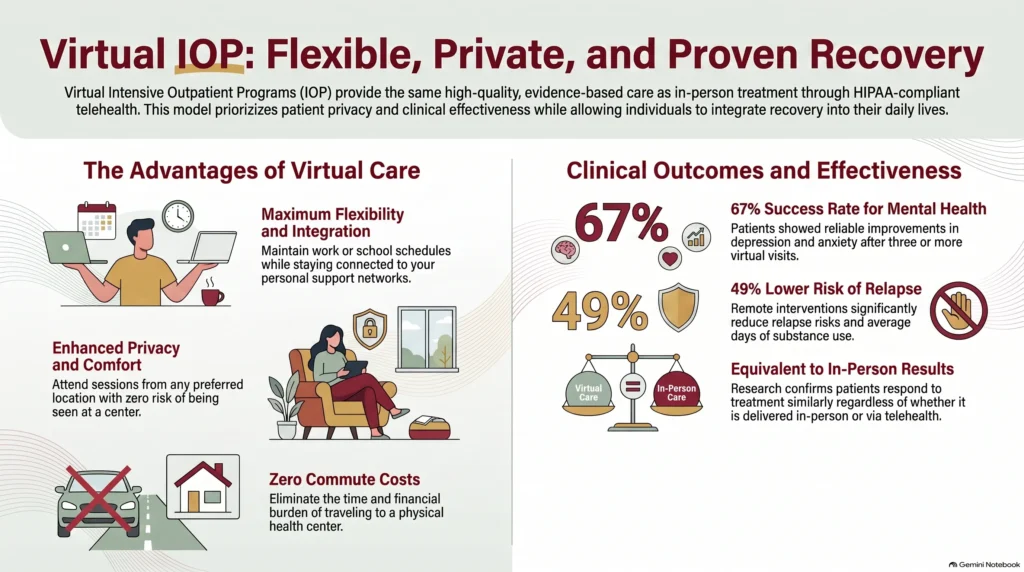
- Greater privacy (sessions can be taken from your preferred location with no risk of being seen while going to the health center)
- Commute times and costs to the center are eliminated
- Utilize digital tools and features to boost how content is delivered
Research also highlights how a virtual IOP can encourage you to be more open and sincere during treatment because of the “online disinhibition effect”, where people feel less restraint talking online compared to in-person [2].
What Are the Outcomes of a Virtual IOP?
Multiple studies support the effectiveness of virtual IOPs. One shows that people had similar responses to treatment regardless of whether IOP was delivered in person or via telehealth [3]. Another revealed that 67% of people experienced reliable improvements in depression and anxiety after three or more virtual mental health care visits [4].
Elsewhere, when remote interventions supplemented in-person care for alcohol and drug treatment, there was up to a 49% lower risk of relapse and a reduction in the average days of use [5].
During the Covid-19 pandemic — when virtual health services were a necessity and were optimized dramatically — depression and suicidal ideation outcomes improved more among virtual IOP patients than in-person IOP patients [6].
Is a Virtual IOP “Better” Than the In-Person Option?
While a virtual IOP is as effective as in-person treatment (and in some contexts, more effective), neither option can be defined as “better”. Both virtual IOP and in-person treatment have their benefits, and both are designed to treat addiction and mental health. What matters most is considering how each program type works, and if that structure suits what you need.
A virtual IOP is suited to someone who has a job, lives in a rural area, who struggles with social interactions, and has a strong support network at home. But a person who lives close to the center, wants to separate treatment and their personal life, and who needs a physical community of peers may prefer in-person treatment. The choice really depends on what resonates most with you.
The big advantage with virtual IOP, though, is that if you ever can’t attend a session, need to travel, or your needs change, you can easily move to receiving treatment on an online basis.
Virtual Intensive Outpatient Program at Red Rock Recovery, Colorado
We offer a virtual IOP that delivers the same high-quality care as our in-person IOP. You receive tailored treatment from licensed clinical professionals, including evidence-based therapy sessions, medication management, and holistic activities adapted to a digital setting.
We use HIPAA-compliant Zoom for Healthcare, meaning all your calls and information are private and protected. We also take care to provide sessions that are built around meaningful progress, rather than simply online check-ins.
For us, a virtual IOP isn’t an easier offering, it’s a genuine alternative to accommodate your needs more precisely and to ensure more people in Colorado and beyond can access truly transformative care.
Your next step can be life-changing. Contact us today.

Sources
[1] Contreras-Schwartz, J. et al. 2024. Patient Engagement in Providing Telehealth SUD IOP Treatment: A Retrospective Cohort Study. Healthcare.
[2] Schuster, R. et al. 2020. Advantages and disadvantages of online and blended therapy: Replication and extension of findings on psychotherapists’ appraisals. Internet Interventions.
[3] Bean, C. et al. 2022. A comparison of telehealth versus in-person group therapy: Results from a DBT-based dual diagnosis IOP. Journal of Clinical Psychology.
[4] Loren, D. et al. 2026. Examining the effectiveness and equity of fully virtual therapy for college students. Journal of American College Health.
[5] Kwan, I. et al. 2025. How effective are remote and/or digital interventions as part of alcohol and drug treatment and recovery support? A systematic review and meta‐analysis. Addiction.
[6] Blalock, D. et al. 2025. Virtual Versus In-Person Intensive Outpatient Treatment for Eating Disorders During the COVID-19 Pandemic in United States–Based Treatment Facilities: Naturalistic Study. Journal of Medical Internet Research.