


















Opioid Use Disorder (OUD) is often successfully treated with Medication Assisted Treatment (MAT), using either Methadone or Suboxone as first-line treatments to manage the painful effects of withdrawal from opioids.
Each approach has its benefits and drawbacks and may work well for some, but not all, of those experiencing OUD. In this article, I explain what these drugs are, how they are used in MAT, and the benefits and limitations of each.
What is Opioid Use Disorder?
Opioid use disorder (also known as opioid dependence or drug addiction) is defined as [1]:
- Maladaptive and persistent strong desires, cravings, and urges to use an opioid
- Difficulty in controlling its use
- The presence of a physiological withdrawal state when its use is tapered quickly or stopped
- Tolerance to the physiological and behavioural effects of the drug
- Neglect of alternative pleasures and interests
- Persistent use of the drug despite harm to oneself and others
Opioid use disorder is not only related to the use of illegal opioid drugs, but also prescription drugs, such as codeine, hydromorphone, oxycodone, morphine, fentanyl, and others.
What Is MAT?
Opioid use disorder can be treated with prescription opioids that help relieve opioid withdrawal symptoms, including cravings, and promote function in everyday living.
The treatment process involves stabilizing the patient through treatments that minimize the effects of drug use on motivation and mental state, or detoxification to minimize withdrawal symptoms. Most importantly, chronic treatment helps prevent relapse.
What Is Methadone?
Methadone is a full mu-opioid receptor agonist. It is indicated for opioid withdrawal (detoxification) or for maintenance treatment in adults diagnosed with a moderate to severe opioid use disorder.
Detoxification using methadone is done by gradual decreases in dose over a period of 180 days or less. A treatment longer than 180 days is considered maintenance treatment. Methadone is also indicated as an analgesic for the treatment of cancer pain (acute and palliative care) or chronic pain.
Methadone is available as an oral solution or as a concentrated oral solution (Methadose, Metadol, Metadol-D), which must be administered in a way that does not lend itself to injection (for example orange-flavored crystal drinks).
Methadone is a Schedule II controlled substance due to the high risk of abuse. Methadone for this purpose cannot be prescribed in the traditional sense (i.e., for a patient to take home from a pharmacy with a written prescription). It can only be dispensed through a federally certified and accredited Opioid Treatment Program (OTP), commonly called a “methadone clinic.”
What Is Suboxone?
Buprenorphine/naloxone (brand name: Suboxone), a tablet taken under the tongue, is a fixed combination of buprenorphine (a partial mu-opioid receptor agonist) and naloxone (a full opioid antagonist or blocker) in a 4:1 ratio.
Naloxone was added to prevent the buprenorphine from being abused by injection. When taken under the tongue, the absorption of naloxone is minimal; however when injected, it can rapidly precipitate opioid withdrawal. This is a disincentive to inject.
It is a Schedule III controlled substance and must be prescribed by a physician. Any healthcare provider who holds a standard DEA registration to prescribe Schedule III-V substances can now prescribe buprenorphine (like Suboxone) for OUD, provided they are licensed under state law to do so.
It is usually dispensed by a pharmacy. There are specific guidelines for filling controlled substance prescriptions.
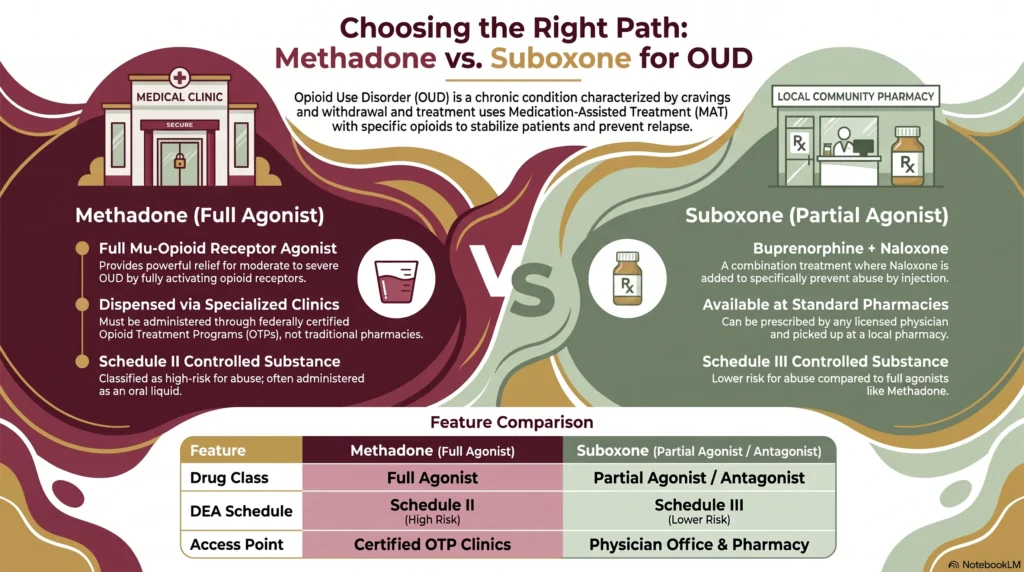
Key Pharmacological Differences
Methadone fully stimulates opioid receptors. This eases severe withdrawal but has a higher overdose risk from respiratory depression.
Suboxone combines partial agonist buprenorphine with antagonist naloxone to deter misuse (e.g., injection). It produces less euphoria and with a safer profile.
Suboxone starts at low doses with gradual increases, unlike methadone’s supervised ramp-up.
Administration and Access
Methadone requires daily dosing at certified opioid treatment programs (OTPs). This provides structure but limits flexibility. Suboxone offers office-based prescribing by physicians or nurse practitioners, with sublingual films or tablets for home use. Methadone is Schedule II (higher abuse potential), while Suboxone is Schedule III.
Effectiveness and Outcomes
Both medications lower death and overdose risks compared to no treatment, with similar overall efficacy. Methadone may suit severe dependence better due to full agonism, while Suboxone aids milder cases or those prioritizing lower misuse risk. Treatment discontinuation is higher with Suboxone (88.8% vs. 81.5% at 24 months) in some cohorts [2].
Comparison of Methadone and Suboxone
The following table summarizes the main differences [3] [4] [5].
| Aspect | Methadone | Suboxone (Buprenorphine/Naloxone) |
| Mechanism | Full agonist | Partial agonist + antagonist |
| Overdose Risk | Higher (respiratory depression) | Lower (ceiling effect) |
| Dosing Location | OTP clinics only | Office/home |
| Best For | Severe OUD | Mild-moderate, flexibility |
| Retention | Slightly higher | Good, but higher dropout |
| Legal Channel | Only through a federally certified Opioid Treatment Program (OTP). | Can be prescribed in an office-based setting (doctor’s office, telehealth) and filled at a retail pharmacy. |
| Prescribing Ability | Not “prescribed” traditionally; dispensed by the OTP. | Prescribed by any eligible DEA-registered practitioner (MD, DO, NP, PA) under state law. |
| Federal Training | Not required for the individual doctor (but OTP has comprehensive rules). | No longer federally required (per MAT Act), but often required by states. |
| Patient Access | Highly structured. Daily clinic visits initially. “Take-homes” earned over time | Much more flexible. Typically involves a monthly prescription and pharmacy pick-up. |
| Regulatory Focus | Program-centric (heavy regulation of the clinic itself). | Prescriber-centric (regulation of the individual practitioner’s license and state rules). |

Find Supportive Care at Red Rock Recovery
Substance use disorder or addiction can feel insurmountable, but Red Rock Recovery Center is here to help you begin your recovery journey today with our core values of Community, Connection, and Purpose.
Red Rock Recovery Center stands out from most drug and alcohol rehab centers in Colorado by offering a full continuum of care approach to substance use disorder (SUD) and addiction treatment.
Our Colorado rehab center is proud to offer an addiction treatment program that includes all necessary steps to healing, from medical detox to aftercare services. Located close to major cities such as Colorado Springs, we are uniquely equipped to help countless families find healing.

Sources
[1] Canadian Agency for Drugs and Technologies in Health (CADTH). 2016. Buprenorphine/Naloxone Versus Methadone for the Treatment of Opioid Dependence: A Review of Comparative Clinical Effectiveness, Cost-Effectiveness and Guidelines [Internet]. Ottawa (ON): Canadian Agency for Drugs and Technologies in Health; 2016 Sep 2.
[2] Nosyk B, et al. Buprenorphine/Naloxone vs Methadone for the Treatment of Opioid Use Disorder. JAMA. 2024;332(21):1822–1831.[ ] CAMH. 2016. Buprenorphine.
[3] Villines Z. Suboxone vs. methadone: What to know. Medicalnewstoday.com
[4] Saxon, A., et al. Medication-assisted treatment for opioid addiction: Methadone and buprenorphine. Journal of Food and Drug Analysis. Volume 21, Issue 4, Supplement, 2013. Pages S69-S7.
[5] Kumar R, et al. 2024. Buprenorphine. [Updated 2024 Jun 8]. In: StatPearls [Internet]. Treasure Island (FL): StatPearls Publishing; 2025 Jan-.